





Skarp kontrast i användningen av stablecoins









 Tether (USDT)
 USD Coin (USDC)
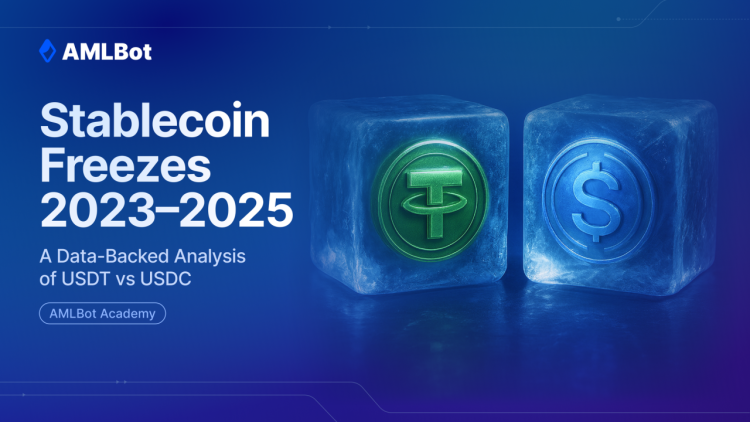
In a revealing analysis of stablecoin regulatory actions, blockchain forensics firm AMLBot has highlighted a significant disparity between the two leading USD-pegged tokens: Tether's USDT and Circle's USDC. According to their latest report, Tether froze approximately $3.3 billion in assets across Ethereum and TRON networks between 2023 and 2025, dwarfing Circle's $109 million in frozen USDC during the same period - a gap of roughly 30 times in value.This data underscores the differing approaches to compliance and asset management in the crypto space, as stablecoins increasingly face scrutiny from global regulators.
Key Insights from AMLBot's On-Chain Analysis
AMLBot's report, based on data from their Dune Dashboard as of October 7, 2025, tracks freeze mechanics, blacklisted addresses, and enforcement patterns for USDT (on ERC-20 and TRC-20) and USDC.Here's a breakdown of the findings:
- USDT issuer Tether blacklisted a staggering 7,268 addresses, freezing $3.29 billion in total - $1.75 billion of which occurred on the TRON blockchain alone. Tether's model is described as proactive, involving collaborations with over 275 law enforcement agencies across 59 jurisdictions. They employ a "burn-and-reissue" mechanism to aid in victim restitution after hacks or illicit activities, allowing for more frequent interventions. Freezes often stem from sanctions compliance, regulatory requests, or user protection measures, with activity peaking in 2024-2025 through higher-frequency, smaller-scale actions.
- In contrast, Circle froze assets in just 372 addresses, totaling $109 million. USDC's freezes are more judicially driven, triggered by explicit legal mandates like court orders or security incidents. Without a burn-and-reissue option, Circle's actions appear in larger, less frequent batches, often tied to major events such as hacks or sanctions enforcement.
The report notes that while both stablecoins saw increased freeze activity in recent years, Tether's scale on TRON (a high-volume network for USDT) contributes to its higher numbers, whereas USDC has minimal presence there. Overall, these mechanisms highlight the centralized control inherent in stablecoins, enabling rapid responses to illicit activities but raising questions about decentralization in crypto.
Broader Context and Industry Reactions
Recent web searches reveal this isn't an isolated trend. For instance, Tether has been involved in high-profile freezes, such as $9 million related to a 2022 Bybit hack resolved in late 2023, and another $85,877 in stolen funds in July 2025, emphasizing their role in combating crypto crime. Circle, meanwhile, has focused on transparency, bridging over $277 billion between banks and blockchains in the year ending October 2023, with USDC circulation surging to $73.7 billion by Q3 2025 amid institutional adoption.
Industry experts, including voices on platforms like LinkedIn, have weighed in on the implications. One analysis suggests the 30x difference isn't just about volume but reflects Tether's broader exposure to global risks versus Circle's more U.S.-centric, regulated framework. As stablecoins capture 75% of institutional OTC volume in H1 2025, such freezes could influence market trust, with Tether's aggressive enforcement potentially deterring bad actors but also sparking debates on centralized power.
This report comes at a time when regulators worldwide are tightening oversight on stablecoins. With combined freezes exceeding $3.4 billion, it serves as a reminder of the trade-offs between security and decentralization in the evolving crypto landscape. As we close out 2025, expect more data-driven insights to shape how issuers balance compliance with innovation.


 Det har lyckligt kopierats... Tack för att du delar vårt innehåll!:



5% insättningsbonus upp till 100 ädelstenar

0% avgifter på insättningar och uttag.





11% insättningsbonus + FreeSpin


EXTRA 10% INSÄTTNINGSBONUS + GRATIS 2 HJULSPINN

Gratis case och 100% välkomstbonus


5 gratisfodral, daglig gratis & bonus

3 gratis casinos och en bonus på 5% på alla kontantinsättningar.

+5% till insättning




Kommentarer