





Resident Evil Requiem levererar två spelstilar, en brutal värld










Capcom's ninth mainline Resident Evil arrived on February 25, 2026, reviewed by IGN's Tristan Ogilvie after a full playthrough of its roughly ten-hour campaign. The verdict landed positive, with the game earning praise for its dual-protagonist structure, zombie behavior overhaul, and boss design, while drawing measured criticism for a second half that tilts heavily toward action and leaves its stealth sections behind. The picture that emerges from the review is a game that knows what it wants to be in two separate chapters — and mostly pulls it off, even if those chapters never fully merge.
The setup begins with Grace Ashcroft, voiced by Angela Sant'Albano, an FBI analyst dispatched to investigate deaths among Raccoon City survivors, several decades after the 1998 outbreak. Her entry point is a shuttered hotel, where she conducts a flashlight-lit forensic search through grimy interiors before being captured by Victor Gideon, the game's primary antagonist, voiced by Antony Byrne. Victor deposits Grace inside the Rhodes Hill Chronic Care Center, a locked-door labyrinth modeled structurally on the Spencer Mansion from the original game. Leon S. Kennedy, voiced by Nick Apostolides and driving a shiny new Porsche, arrives to mount a rescue — though the strange bruising across his skin suggests a T-Virus-adjacent affliction that the game leaves open as a thread.
Rhodes Hill dominates the early hours and operates entirely on resource scarcity. Grace carries a small number of inventory slots, moves slowly enough that avoiding zombies requires precise crouch-walking along planned routes, and finds so little ammunition that each pistol shot registers as a genuine decision. The guns fire with a startling physical weight — bullets strip flesh from zombie faces and leave eyeballs hanging, while blood sprays onto walls and stays there when you return to the same corridor later. Grace also carries a blood collector that lets her syringe infected plasma from zombie corpses and combine it with scrap to craft medkits and hemolytic injectors. The injectors, when pressed into the spine of an unaware enemy, cause the body to swell and detonate in what the review describes as the most satisfying stealth kill available. Used on a downed zombie before backtracking through an area, they also prevent reanimation, which matters because Requiem's undead mutate and return unpredictably.
The zombies themselves received a significant behavioral redesign. These are not the groaning, foot-dragging enemies from the 1998 outbreak. Some flick light switches on and off without apparent purpose. Others mutter and laugh to themselves before dropping to their knees to feed on a fallen companion. The review draws a comparison to the werewolves of Resident Evil Village and concludes that these retained traces of humanity make the Rhodes Hill zombies more unsettling by a considerable margin.
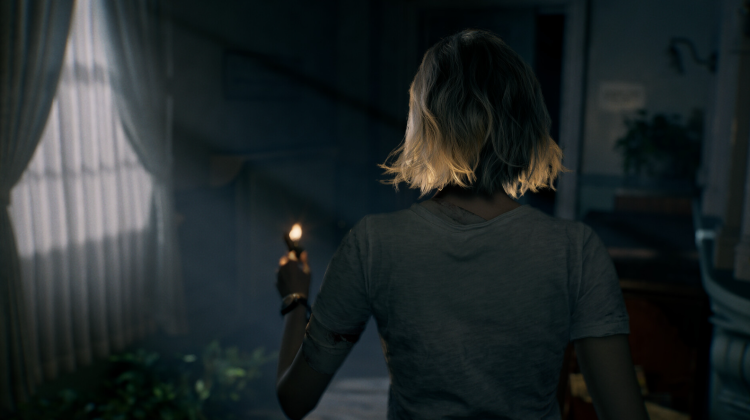
Grace's sections unfold as a sustained exercise in environmental puzzle-solving alongside the stealth. Locked doors require working through a sequence of body part-based riddles, and the layout of the hospital means that the player rarely has advance knowledge of what waits around the next corner. The review notes that a grotesquely large enemy squeezing down a hallway toward the player generates a specific dread that the slower pacing enables — a confrontation that faster gameplay would neutralize. This architectural patience, the review argues, is what makes the scares land.
Leon's sections default to a third-person perspective and arrive initially as brief interruptions to Grace's stealth sequences before expanding substantially in the second half. The gear differential between the two characters is total. Leon carries shotguns, sniper rifles, and a durable hatchet maintained with an everlasting flint. He kills enemies who drop weapons — fire axes, lead pipes — and can immediately scoop them up and launch them at nearby targets, a mechanic the review compares favorably to the sword-flinging in Ghost of Yotei. He also gains access to a chainsaw, escalating the combat into what the review describes as Dead Rising levels of delirium. Currency drops from every kill and cashes out at an in-game ATM for weapon upgrades, ammunition, and body armor.
The boss encounters land predominantly in Leon's chapters. The review calls out a fight inside a cramped chapel that initially looks like a standard weak-point exercise — blast the glowing blisters covering the monster's torso — but then reveals that each burst also sprays infection onto surrounding zombies, mutating them into stronger variants mid-fight. The design subverts the expectation that firepower alone resolves the encounter. No boss is singled out as a failure, which the review notes with explicit relief, given the franchise's history of uneven setpieces.
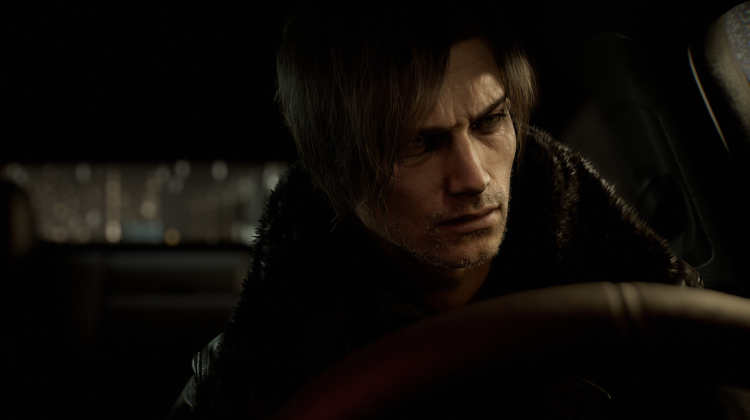
Dad jokes follow Leon through most of his major kills. Every significant zombie dispatched receives a deadpan one-liner, which the review treats as consistent with the character and the series's longstanding willingness to put comedy directly next to carnage.
Grace, by contrast, draws the review's most direct praise as a character. Resident Evil has historically leaned into exaggerated campiness, and the reviewer positions her as a departure — a protagonist whose arc from near-constant panic to controlled self-sufficiency reads as the most human the series has produced. The review tracks this evolution as the campaign's emotional spine, running parallel to the mechanical shift from vulnerability to competence.
I find the dual-protagonist concept here genuinely winning — not just as a design choice, but as a franchise strategy. Leon packages everything longtime fans already know they love: the banter, the brutality, the Resident Evil 4 muscle memory firing on contact. Grace does something structurally different. She gives someone arriving with no history in the series — or even in survival horror broadly — a character whose learning curve mirrors their own. She doesn't know the rules either. She flinches. She miscalculates. That identification point matters more than it gets credited for in franchise games, because without it, the barrier to entry is the entire back catalogue. And here I want to say something directly: never start a long-running series from the beginning. Entry one means the oldest hardware, the oldest design conventions, and the highest chance of bouncing off and walking away before reaching the installments that justify the franchise's reputation. Start at the top-rated entry, or the most recent one with strong reviews — fall in love there first, then loop back to the origins with context and motivation already in place. Resident Evil Requiem makes that argument without trying to. It hands a newcomer, Grace, and a veteran, Leon, and runs them through the same world at the same time.
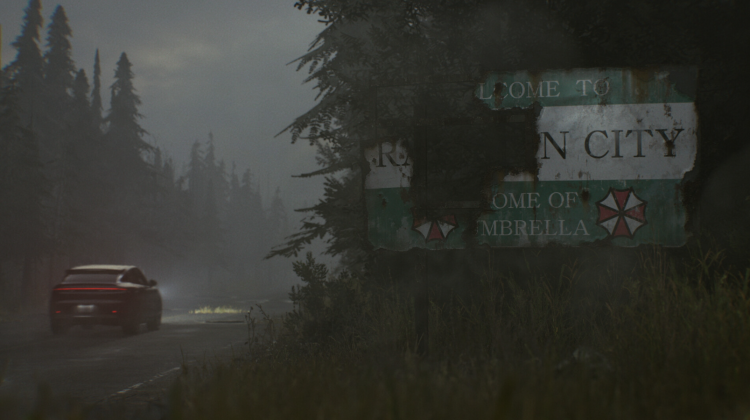
The review's structural criticism focuses on the back half. Once the story moves out of Rhodes Hill and into the remains of Raccoon City, Leon takes over for a roughly five-hour continuous stretch. A highway chase sequence and Call of Duty-style artillery strikes push the action register higher than any prior Resident Evil entry. The reviewer names Resident Evil 4 as a personal favorite and still found himself wanting more Grace — specifically more of her stealth sequences as a tonal counterweight to Leon's uninterrupted carnage. The balance tips in the review's reading because the two halves that make up Requiem's identity never interleave properly. The frights front-load. The gunplay back-loads. The review offers the image of a whiskey and Coke served in two separate glasses instead of mixed.
A late-game stealth section, set in a facility populated by returning monsters from earlier series entries, provides partial relief. It arrived too close to the ending, in the review's assessment, to fully correct the pacing. Grace's absence through a long central section is justified by the story — her disappearance from playable sections is not arbitrary — but justified and satisfying are different things.
The campaign's narrative delivers several twists that reframe the origins of the Umbrella Corporation and the intentions of its founder. Notes and documents scattered through the environments carry two separate functions: some are load-bearing for understanding Grace's abduction and her personal history, and some are written as jokes. A medical file diagnosing a singing zombie with Main Character Syndrome is cited as a specific example of the latter. The tonal range in the written material reflects the same dual register as the gameplay — dread punctuated by absurdity.
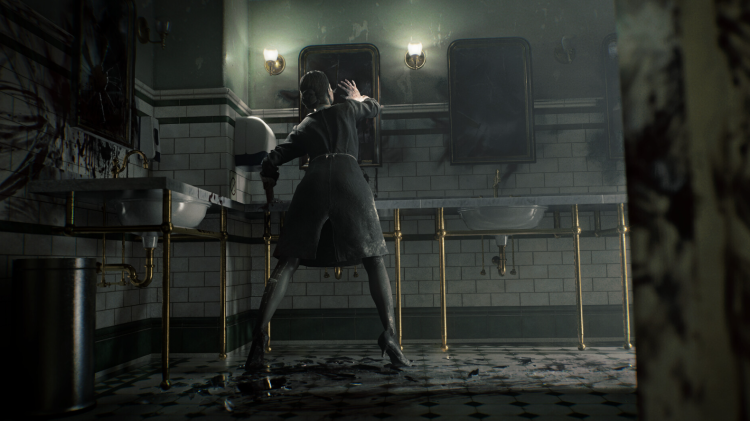
One location explored by Leon late in the game appears in pre-release trailers and is described in the review as packed with Easter Eggs for players who have been with the franchise since its original PlayStation release. The reviewer declines to name it.
The post-campaign situation draws direct criticism. The Mercenaries mode, which returned in Resident Evil Village in 2021, is absent from Requiem. The in-game challenge system offers unlockable weapons and costumes for repeat runs, but the review characterizes these as a thin substitute. The call for a post-launch patch echoes the free update that eventually added Mercenaries content to the Resident Evil 4 remake.
Across the full ten hours, the review treats the Grace sections as the game's most accomplished work and the Leon sections as the most immediately enjoyable, with the caveat that their separation rather than integration leaves the experience feeling like two distinct games occupying the same disc. The framing holds: both are worth playing, and both do what they set out to do. The regret is architectural — that Capcom found two strong formulas and ran them consecutively instead of intertwining them.
Resident Evil Requiem was released on February 25, 2026. Capcom has not announced post-launch content plans. The review was published by IGN.


 Det har lyckligt kopierats... Tack för att du delar vårt innehåll!:



5% insättningsbonus upp till 100 ädelstenar

0% avgifter på insättningar och uttag.





11% insättningsbonus + FreeSpin


EXTRA 10% INSÄTTNINGSBONUS + GRATIS 2 HJULSPINN

Gratis case och 100% välkomstbonus


5 gratisfodral, daglig gratis & bonus

3 gratis casinos och en bonus på 5% på alla kontantinsättningar.

+5% till insättning




Kommentarer