




Saros recension










 PlayStation
 Review
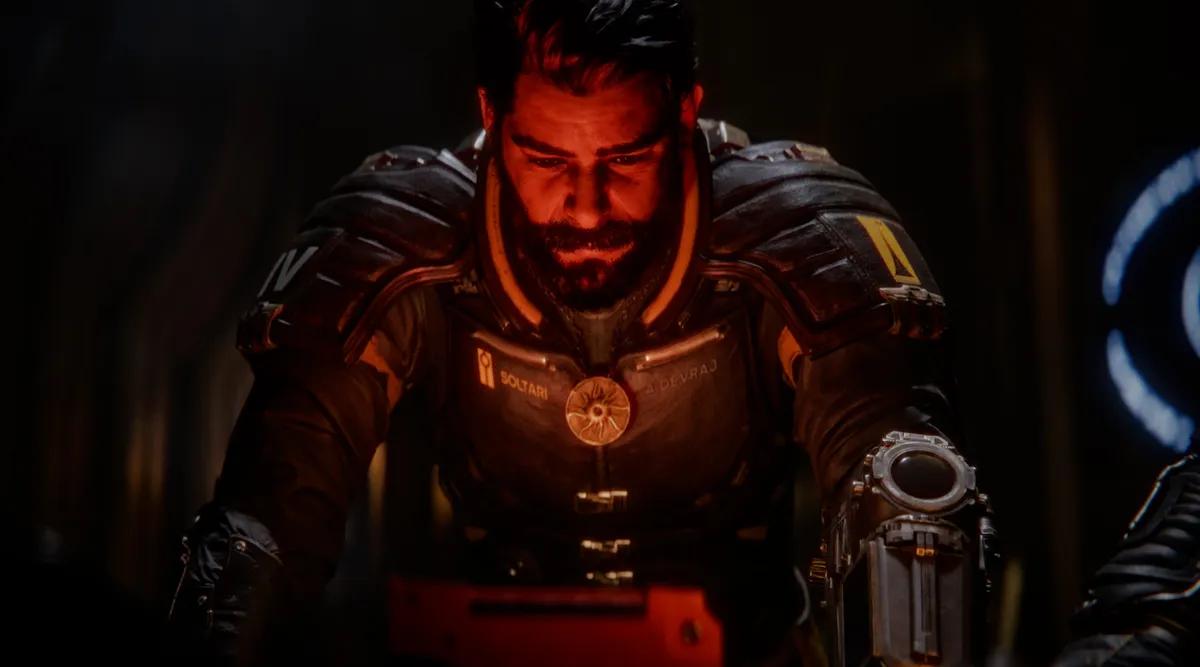
Housemarque follows the success of Returnal with Saros, a third-person shooter that transitions arcade sensibilities into a massive three-dimensional environment. Players assume the role of Arjun Devraj, an enforcer searching for missing colonists on the shifting planet Carcosa. The game utilizes Unreal Engine 5 to render complex particle effects and organic alien environments during high-speed combat encounters. Sony Interactive Entertainment publishes this title as a first-party exclusive for the PlayStation 5 console.
Colonial Ambitions and the Hostility of Carcosa

The narrative of Saros centers on the Soltari corporation and its attempts to colonize and mine the resources of the planet Carcosa. Three previous waves of colonists, known as Echelons, have vanished without a trace from the surface. Arjun Devraj arrives with Echelon IV, a smaller rescue-focused team that immediately suffers a catastrophic crash upon entering the atmosphere. This setup establishes a base camp where the few survivors attempt to maintain their sanity amidst the shifting geography of the planet. Carcosa functions as a sentient or at least highly reactive environment that rearranges its internal layout every time Arjun dies and returns to the crash site. The planet is characterized by desolate ruins, industrial alien complexes, and blood-red marshes that suggest a history of advanced but now decaying civilization.
Arjun is an enforcer with a clouded past, portrayed through the performance of Rahul Kohli. The protagonist experiences visions and cryptic imagery delivered through quick cuts during his explorations. These glimpses into his history suggest a personal motivation for taking this mission beyond simple corporate duty. The Soltari corporation itself is presented as an all-consuming entity with ethics comparable to the most ruthless science fiction conglomerates. Throughout the exploration of Carcosa, Arjun discovers audio logs and notes left by the previous echelons. These recordings detail the slow descent into madness experienced by the earlier settlers. The environment is further populated by strange, plant-like structures and writhing tentacles that react to Arjun's presence, utilizing custom physics tech to simulate organic movement.
Combat Dynamics and the Soltari Shield Mechanic

Combat in Saros requires players to navigate dense patterns of projectiles that fill the screen during every encounter. Enemies utilize a variety of attack types, including spheres, lasers, and shockwaves, often color-coded to indicate their properties. Blue projectiles form the bulk of enemy fire and can be interacted with via the Soltari Shield. I think the addition of a projectile-absorbing shield transforms the defensive rhythm into an offensive resource-gathering exercise. This shield mechanic allows Arjun to soak up blue energy, which then charges his Power Weapon. This creates a loop where the player must intentionally position themselves in the path of certain projectiles to gain the energy needed for a high-damage counterattack.
The arsenal available to Arjun includes a variety of third-person shooter staples, such as rifles and shotguns, alongside more exotic alien hardware. Every weapon features an alternate fire mode and a primary fire mode. These are mapped to the PlayStation 5 DualSense adaptive triggers; a partial pull of L2 activates the alternate fire, while a full pull engages the power weapon once it is sufficiently charged. The game also incorporates an active reload system termed Adrenaline. Successive perfect reloads provide cumulative stat buffs, though the timing is tight and requires constant attention during chaotic fights. Many early-game weapons include a degree of auto-aim, represented by a dotted line connecting the reticule to the nearest hostile target. As players progress into deeper biomes, this assistance diminishes, forcing a reliance on precise manual aiming and movement.
Environmental Shifts through the Eclipse System

The Eclipse system serves as the primary difficulty modifier and reward mechanic within each run. Throughout the various biomes, Arjun encounters structures resembling grasping hands sprouting from the ground. Interacting with these hands triggers a solar eclipse that fundamentally alters the environment and enemy behavior. The world is bathed in a reddish hue, and dormant machinery springs into life. During an eclipse, standard blue projectiles are often replaced by yellow orbs that cause Corruption. This status effect reduces Arjun's maximum health, a penalty that can only be cleared by successfully landing a special attack. The stakes of an encounter increase significantly under the eclipsed sun, as the hazards become more lethal and the environmental navigation more complex.

The trade-off for this increased hostility lies in the quality of the loot. Artifacts found during an eclipse are more powerful than their standard counterparts but include negative modifiers. A player might gain a significant boost to health regeneration on kills at the cost of incurring fall damage or having a slower dash cooldown. This creates a high-stakes gambling mechanic where players must decide if their current build can survive the increased pressure of an eclipse for the sake of long-term power. The procedural generation ensures that rooms encountered during an eclipse feature different enemy compositions and hazard placements than they do under normal lighting. Some runs might require an eclipse to bypass specific environmental barriers or to reach the keystone boss of a region.
Progression Systems and Suit Customization

Saros employs a modern roguelite structure where death is a setback but not a total reset. When Arjun returns to the base camp, players can spend resources collected during their run on permanent suit upgrades. These upgrades include increases to base health, defense, and attack power, as well as the unlocking of additional artifact slots. The progression system also includes the acquisition of permanent abilities, such as a grapple hook or the ability to use jump pads. These tools are essential for reaching previously inaccessible areas of Carcosa and are often guarded by the major bosses at the end of each biome. Once a biome is cleared and its boss defeated, players can utilize a teleportation system to skip directly to later areas in subsequent runs.
I find that the teleportation system allows for rapid experimentation with late-game biomes without the repetition of earlier zones. While skipping early areas means missing out on some potential artifacts and stat boosts, the permanent suit upgrades provide a baseline level of competency that makes these shortcuts viable. The game also features a challenge system that appears in the mid-game, allowing players to apply specific modifiers to their runs. These modifiers carry point weightings, requiring a balance of positive and negative effects to proceed. This allows for a highly customized difficulty level, catering to those who want a more forgiving experience or those seeking the most hostile version of Carcosa possible. The skill tree is described as a skill trunk, with most major branches gated behind specific narrative milestones and boss kills.
Technical Implementation and Hardware Integration

The technical execution of Saros utilizes the capabilities of the PlayStation 5 and Unreal Engine 5. The game maintains a high frame rate even when the screen is saturated with thousands of lit particles from exploding enemies and projectile patterns. 3D audio is used extensively to provide directional cues for incoming attacks and the sounds of the environment. Players can hear the specific rustle of tentacles or the hum of charging lasers from behind, allowing for better spatial awareness in the three-dimensional bullet hell. The haptic feedback on the DualSense controller is refined, providing distinct sensations for different weapon types and environmental interactions. Walking through a marsh feels different from sprinting across metallic industrial flooring through the vibrations in the controller.
The visual design emphasizes the contrast between the dark, oppressive atmosphere of the alien ruins and the bright, neon-colored projectiles of the enemies. Particle effects are used not just for visual flair but as a functional part of the combat feedback loop. When an enemy is destroyed, it erupts in a shower of sparks and energy that signals a successful kill. The lighting engine handles the transition to eclipse mode seamlessly, shifting global illumination to reflect the obscured sun. Loading times are nearly instantaneous, allowing Arjun to transition between biomes or return from the base camp to the planet surface within seconds. The soundscape is composed by Sam Slater, featuring a soundtrack that shifts from ambient dread to high-intensity electronic rhythms during combat.
Narrative Structure and Thematic Influences

The storytelling in Saros is multifaceted, combining traditional cutscenes with environmental storytelling and audio logs. While the core plot involves the search for the missing echelons, the narrative also explores themes of corporate greed and cosmic dread. The game draws heavy influence from Robert W. Chambers’ The King in Yellow, a connection that becomes increasingly apparent as Arjun delves deeper into the history of Carcosa. Some critics have noted that the sheer volume of audio logs and external characters can lead to narrative clutter, making it difficult to track every plot thread while simultaneously dodging projectiles. Unlike Returnal, which focused on a single character’s internal struggle, Saros attempts a broader scope with multiple survivors and a complex corporate backstory.
Arjun's interactions with the other survivors at the base camp change over time, reflecting their deteriorating mental states. The character animations outside of the main cinematic cutscenes can appear stiff, and the dialogue sometimes backlogs if multiple story milestones are reached in quick succession. However, the mystery of the planet and the nature of the eclipses remain a strong hook for continued play. The narrative successfully avoids body horror in favor of a more psychological and cosmic brand of terror. The ending of the game involves several large-scale encounters that feel like final boss fights, extending the playtime beyond initial expectations. Despite the complexity of the cast, Arjun remains the central focus, and his personal connection to the planet's anomalies provides the emotional core of the experience.
Verdict

Saros is an 8/10 game. It offers a technically proficient and visually arresting action experience that refines the third-person bullet hell genre.
Pros
- High-quality Unreal Engine 5 visuals and particle effects.
- Satisfying integration of PS5 haptics and 3D audio.
- Engaging shield and eclipse risk-reward mechanics.
Cons
- Narrative clutter through excessive audio logs and characters.
- Input complexity regarding the adaptive trigger alt-fire.
The combat system provides a consistent challenge for players who value mechanical precision and fast-paced movement. Housemarque demonstrates continued expertise in translating arcade gameplay into a high-budget console environment. The permanent progression systems ensure that the difficulty remains manageable even during the game's most intense encounters.


 Det har lyckligt kopierats... Tack för att du delar vårt innehåll!:



5% insättningsbonus upp till 100 ädelstenar

0% avgifter på insättningar och uttag.





11% insättningsbonus + FreeSpin


EXTRA 10% INSÄTTNINGSBONUS + GRATIS 2 HJULSPINN

Gratis case och 100% välkomstbonus


5 gratisfodral, daglig gratis & bonus

3 gratis casinos och en bonus på 5% på alla kontantinsättningar.

+5% till insättning




Kommentarer