




How Winning Stakers Actually Pick Players (It's Not Luck)

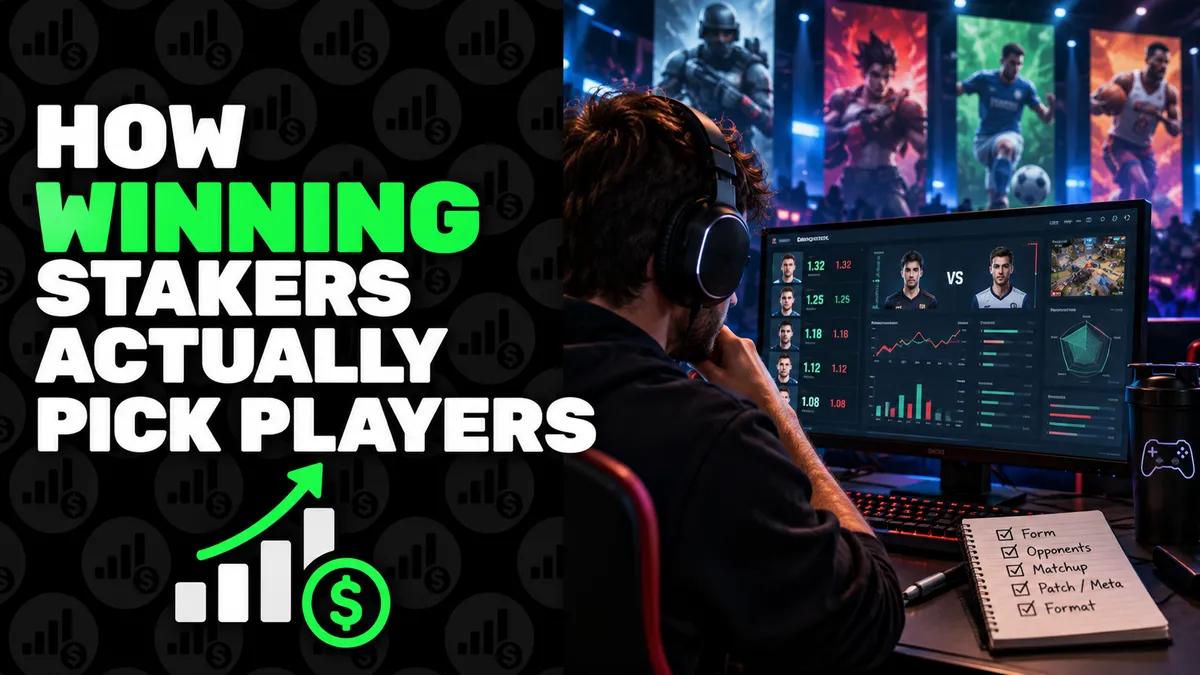
The best-informed esports picks are not guesses: they come from checking recent form, quality of opposition, roster or character matchups, the current game patch, and the exact match format. That research can improve a pick, but it cannot remove uncertainty; even a strong player can lose a short live match.
A famous name may have the stronger résumé, but the sharper pick usually comes from asking a narrower question: who is better prepared for this game, opponent, and format today?
Is picking an esports winner skill or luck?
Knowledge helps a fan identify meaningful advantages, while the match itself still contains missed inputs, unusual strategies, momentum swings, and other variables.
The skill lies in separating useful signals from noise. A five-match winning streak against weak opposition may say less than a close loss to an elite opponent. A dominant overall record may hide a bad map pool in Counter-Strike 2, a difficult character matchup in Tekken, or a player struggling with the latest Madden update.
Research becomes more meaningful as a process: consistently checking the same factors, avoiding emotional picks, and recording why each selection was made. That does not guarantee a profit. It simply makes the decision evidence-based rather than random.
What do experienced stakers research first?
The first check is not a player's lifetime win rate. It is the match card.
Format changes the value of every other statistic. A best-of-one leaves less time for the stronger player to recover from a slow start than a longer set. A specific CS2 map can favor one competitor's habits. In a fighting game, a first-to-two set gives little time to solve an unfamiliar character. In Madden or EA FC, a ruleset may affect team selection, game length, and pace.
Once the format is clear, a practical order of research looks like this:
- 1v1Me Power Rankings. Power Rankings on 1v1Me are the number displayed next to each player’s name. They are calculated using stats from the player’s last 50 games and can help indicate which player may be stronger, but they do not guarantee the outcome.
- Recent comparable form. Review the last five to ten relevant matches, not a player's whole career. Give extra weight to the same game version, mode, map, or set length.
- Opponent quality. Check who those wins and losses came against. Strong statistics built against weaker players can be misleading.
- Head-to-head history. Use it when the sample is recent, and the conditions match. Old meetings from a previous patch, roster, or game edition deserve less weight.
- Playstyle matchup. Ask how the players win. A patient counter-puncher may trouble an aggressive fighting-game player; a disciplined CS2 player may punish repeated opening risks.
- Roster, role, or character changes. A new teammate, role swap, controller change or newly adopted main can make older data less useful.
- Patch and meta knowledge. Balance updates can change weapons, characters, formations, and optimal strategies overnight.
- Schedule and setting. Travel, back-to-back matches. Although these factors should not become excuses for ignoring the numbers.
This is also where community discussion can help. 1v1Me live chat with other stakers and commentators, 1v1Me Staker Discord server, Reddit threads, gaming Discord servers, and player streams.
Which player statistics actually matter?
The useful numbers depend on the game. Raw wins and kills are a starting point, not a complete model.
| Game | Useful evidence to check | Context that can change the pick | Common mistake |
| Call of Duty | Recent map record, slaying, first-blood impact, objective work, Search and Destroy form | Map, role, and team chemistry | Judging every player only by kills |
| Counter-Strike 2 | Rating, damage per round, opening duels, trading, clutches, map record | Opponent strength, economy, side, map | Comparing player ratings without considering maps, opponents, or match context |
| Madden | Turnover rate, red-zone conversion, third-down decisions, clock control | Team choice, playbook, game update, and ruleset | Assuming NFL team strength equals player skill |
| NBA 2K | Shooting efficiency, turnover rate, defensive stops, pace and late-game execution | Team or build selection, format and current patch | Overreacting to one high-scoring game |
| EA FC | Chance creation, shot quality, finishing, defensive errors and game management | Formation, squad restrictions, patch and matchups | Using possession as a proxy |
| Tekken | Character matchup, punishment, movement, round conversion and adaptation | Main or secondary character, set length | Trusting rankings without matchup context |
Street, Fighter | Neutral control, anti-airs, resource use | Character matchup, control scheme, set length | Ignoring how styles interact |
Counter-Strike offers a good example of why context matters. HLTV's Rating 3.0 adjusts for economy and adds Round Swing, which estimates how much an action changes a team's chance of winning a round. A kill against a poorly equipped opponent is not treated like a decisive clutch. Even then, one composite rating cannot fully capture role, opponent strength, map fit, or a small sample.
How much should recent form matter?
Recent form matters, but recency must be balanced against sample size.
A useful approach is to split the record into three windows: the last few matches, the last month, and the longer baseline. If all three point in the same direction, the signal is stronger. If a player looks excellent across three matches but average across 30, investigate what changed before calling it improvement.
There may be a real explanation: a favorable patch, a new role, a switch of character, or a settled roster. There may also be no durable change at all. Hot streaks attract attention precisely because they are visible, which makes them easy to overvalue.
Quality of opposition is the check that prevents the biggest mistake. A 70% recent win rate is not equally informative against every schedule. Results against players of similar or greater ability deserve more weight than a run through mismatched opposition.
Why do rosters, patches, and the meta change a pick?
Esports data ages quickly. Traditional sports teams change too, but a game update can alter the competitive environment for every player at once.
In a shooter, a weapon adjustment can reduce the value of a familiar setup. In EA FC or Madden, changes to defending, passing, or player behavior can reward a different style. A Tekken or Street Fighter balance patch can turn a previously comfortable matchup into a problem. Results recorded before that change may still describe general ability, but they are less precise evidence for the next match.
Team context also affects individual performance. A Call of Duty player's statistics can rise or fall after a role change. A Counter-Strike entry player may post a modest rating while creating space for teammates. When the roster changes, historical averages from the old system should not be carried forward without adjustment.
This is why informed stakers read news as well as stat pages. Transfer reports, patch notes, tournament results, and player interviews can explain why a number moved.
What is a simple checklist before backing a player?
Before confirming a stake, an informed user should be able to answer six questions:
- What exactly is the format and teams/characters chosen by the players?
- How has each player performed recently under comparable conditions?
- Does one playstyle, map, team, or character create a matchup advantage?
- Has a roster move, role change, or patch made older results less relevant?
- Am I choosing from evidence, or reacting to a famous name, streak or community narrative?
If the information is thin, passing is also a decision. An always-on slate does not make every match equally readable.
Sign up for 1v1Me using this link to get a $25 No Sweat Stake. Use code: EGW. If your stake loses, you’ll get up to $25 back!


 Det har lyckligt kopierats... Tack för att du delar vårt innehåll!:



5% insättningsbonus upp till 100 ädelstenar

0% avgifter på insättningar och uttag.





11% insättningsbonus + FreeSpin


EXTRA 10% INSÄTTNINGSBONUS + GRATIS 2 HJULSPINN

Gratis case och 100% välkomstbonus


5 gratisfodral, daglig gratis & bonus

3 gratis casinos och en bonus på 5% på alla kontantinsättningar.

+5% till insättning




Kommentarer