




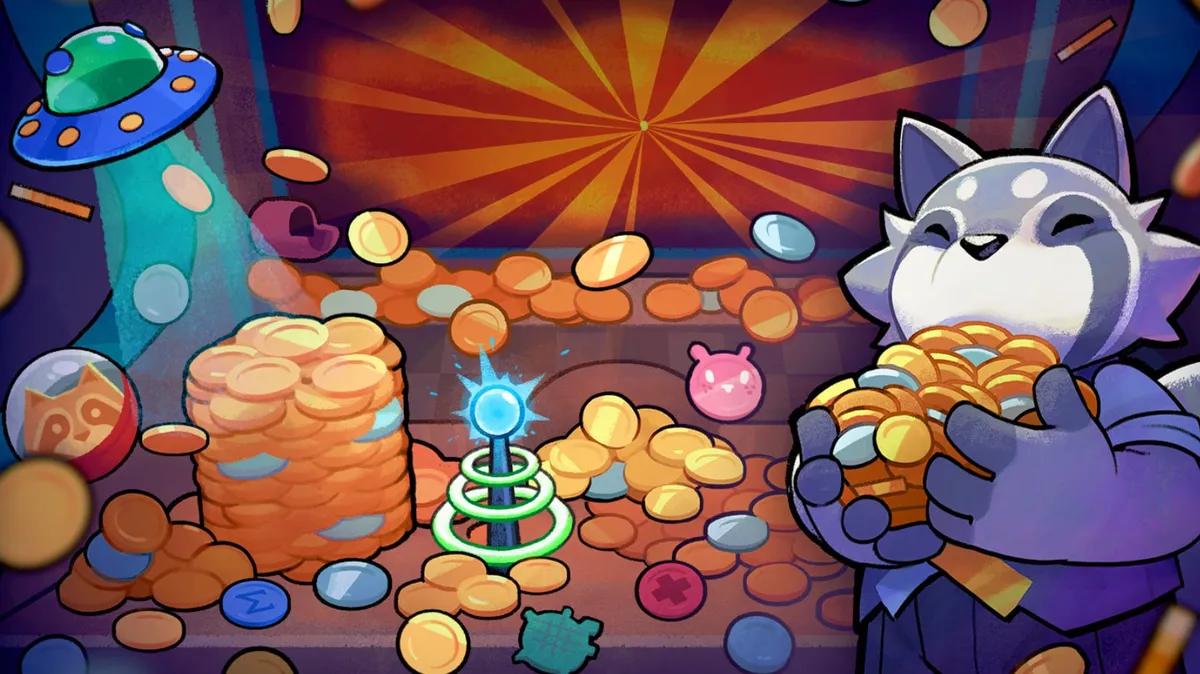
RACCOIN: Coin Pusher Roguelike Recension










 Steam
Steam Review
Doraccoon and publisher Playstack released RACCOIN: Coin Pusher Roguelike on Steam to combine arcade physics with deep strategic progression. The title utilizes a classic coin-pusher interface where players drop gold discs into a shifting field to reach specific score thresholds. Development credits include producer Xinyi Ma, artists Ming Tang, and designer Hongpeng Luo. This mechanical blend transforms a simple gambling machine into a calculated roguelike experience.
The Core Loop and Physical Mechanics
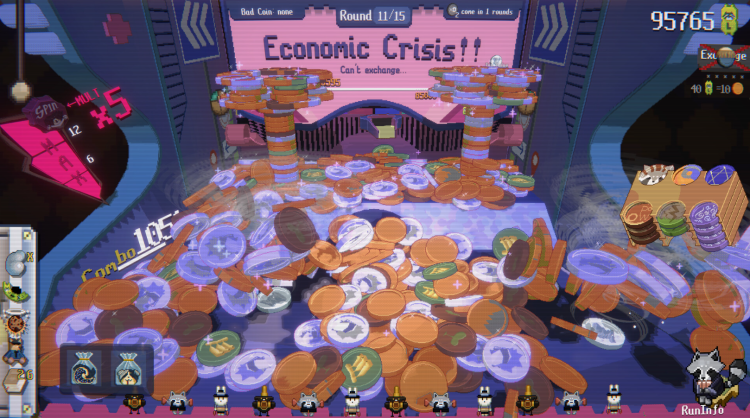
The game operates on a simulation of a standard arcade coin pusher, often referred to as a penny falls in Scotland. A moving metal arm continuously slides across a flat tray, pushing any items toward a lower ledge. Players must drop coins from the top of the screen to impact the existing pile. If the force of the drop and the movement of the slide push metal over the front edge, the player earns points and currency. Scoring depends entirely on the volume and value of the objects that fall into the bottom prize zone.
The software utilizes a physics engine that calculates the weight and trajectory of every individual disc. A coin that lands flat provides a stable base for others, while a disc that lands on its edge can cause the entire pile to shift in unpredictable directions. This variability introduces a layer of chaos that separates the experience from static deckbuilders. The tray remains in constant motion, requiring the player to time their drops with the rhythm of the sliding mechanism. Successful runs depend on understanding how momentum transfers through a dense field of metal.
The game structures the challenge around a series of fifteen rounds. Each round increases the required score threshold, forcing the player to improve their scoring efficiency through upgrades. Failure to reach the target score within the allotted number of coins ends the run. This progression mirrors the stake-based systems found in modern roguelike titles. I see the intricate physics of the coin tray as the primary driver of both success and frustration. The physical reality of the machine means that even a perfect strategy can occasionally fail due to a single rogue bounce or a poorly timed slide.
Modifiers and Special Coin Variety
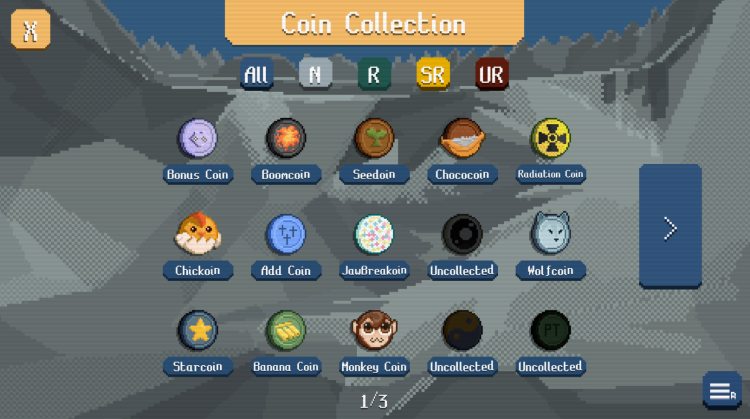
The depth of the experience comes from the interaction of over 150 unique special coins. These modifiers appear in the shop or through random drops during a round. A standard gold coin provides a base score, but special variants introduce magical or technological effects that alter the state of the field. One common variant is the explosive coin, which detonates upon landing and sends surrounding discs flying in every direction. This can clear a crowded tray or cause a chain reaction that pushes dozens of coins over the ledge at once.
Other modifiers focus on infecting the field with specific traits. The zombie coin infects any adjacent discs with its own properties, allowing a player to create a massive cluster of high-value objects. A growth coin increases the physical size of any coin it touches, which adds more mass to the pile and increases the pressure on the ledge. The tornado coin creates a localized vortex that sucks in surrounding items, concentrating them into a small area for a more focused push. These effects can stack in complex ways, such as an explosive coin detonating a cluster of giant zombie coins.
The game also features a predator-prey mechanic with the wolf and pig coins. A wolf coin will move across the tray to consume pig coins, increasing in value with every meal. The player must then maneuver the high-value wolf coin toward the scoring zone without it falling off the side edges of the machine. This requires precise placement to guide the wolf through the shifting metal. The variety of these interactions ensures that no two runs feel identical. Players must constantly adapt their strategy to the specific set of modifiers currently active on the board.
Progression and Economic Systems
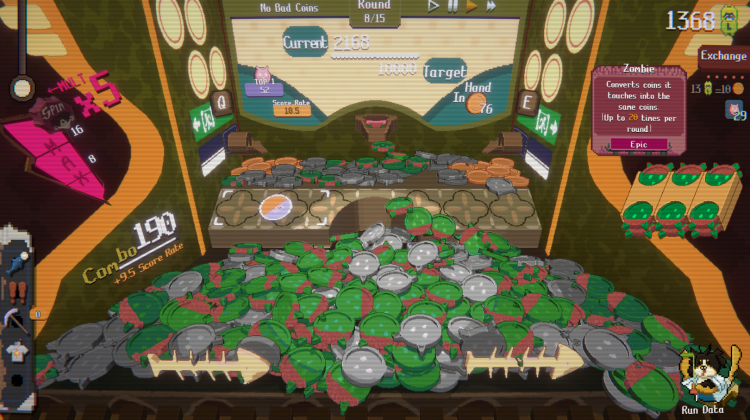
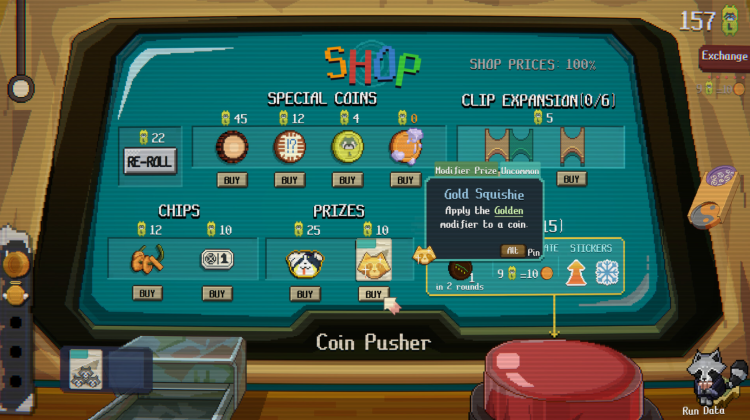
Between every active round, players visit a shop to spend the tickets earned from their scoring performance. The shop offers a variety of items, including new special coins and permanent passive buffs called Chips. These Chips function similarly to jokers or relics in other roguelikes, providing benefits that last for the remainder of the run. A Chip might grant a percentage chance to return a dropped coin to the player's inventory or increase the score value of all coins by a flat multiplier. The cost of these items scales as the run progresses.

The game utilizes a system of Cards and Tickets to define the parameters of a run. A Card selection determines the starting deck of coins and initial passive abilities. One character, the raccoon, might start with coins that generate more tickets, while another character focuses on explosive power. Tickets serve as difficulty modifiers that add negative constraints in exchange for higher score potential. These difficulty tiers go up to level eight, providing a significant challenge for experienced players.
Managing the economy is critical for survival in the later rounds. Players must decide whether to save their tickets for expensive high-tier Chips or spend them on immediate survival via single-use special coins. The shop inventory is randomized, requiring the player to build around the options provided rather than following a single predetermined path. This economic tension forces hard choices when a powerful item appears but the player lacks the funds to purchase it. Successful players learn to balance short-term point gains with long-term build development.
Randomness and Negative Variables
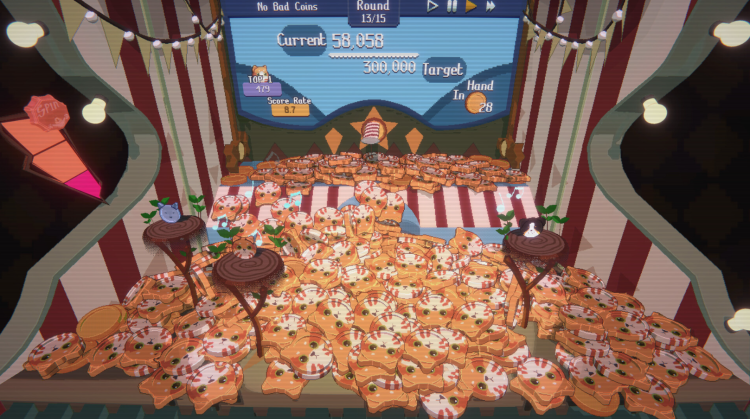
The game introduces negative elements to prevent the player from becoming too powerful without opposition. Bad Coins fall into the field at random intervals, acting as boss mechanics for the rounds. These coins carry detrimental effects, such as disabling the score multiplier or preventing the player from using the shop. To remove these effects, the player must physically push the Bad Coin off the ledge and into the scoring zone. This creates a defensive priority where the player must ignore scoring opportunities to deal with the immediate threat.
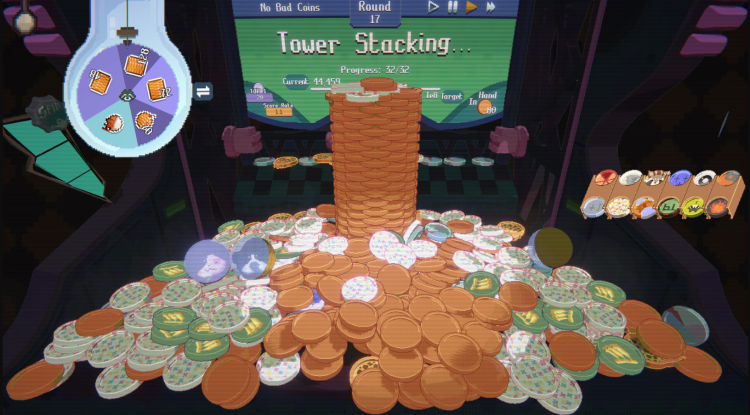
A prize wheel system adds another layer of randomized rewards. When a player achieves a specific score multiplier, they earn a spin on a wheel that can grant extra coins, tickets, or temporary buffs. Landing on the bonus segment of the wheel leads to a secondary wheel with even greater rewards. These rewards can include the spawning of massive coin towers that instantly fill the tray with hundreds of discs. These moments of extreme abundance are often the highlight of a run, turning a struggling effort into an overwhelming success.
The physics engine occasionally creates scenarios that feel beyond the player's control. A pile of coins might shift unexpectedly toward the side gutters, where they fall without contributing to the score. This lack of agency is a deliberate design choice that reflects the nature of actual coin-pusher machines. While frustrating, it forces the player to build redundancy into their strategy. I think the comparison to Balatro is apt because the game turns simple numbers into a high-stakes dopamine loop. The player is always one lucky bounce or one well-timed explosion away from a massive payout.
Character Diversity and Meta-Progression
Six playable characters offer distinct starting conditions and exclusive coins. The raccoon is the primary mascot and offers a balanced approach to the game mechanics. Other characters introduce more specialized playstyles, such as focusing entirely on physics-based manipulation or economic greed. Unlocking these characters requires completing specific milestones or reaching certain difficulty levels. This variety encourages players to experiment with different mechanical archetons to find a style that suits their preferences.
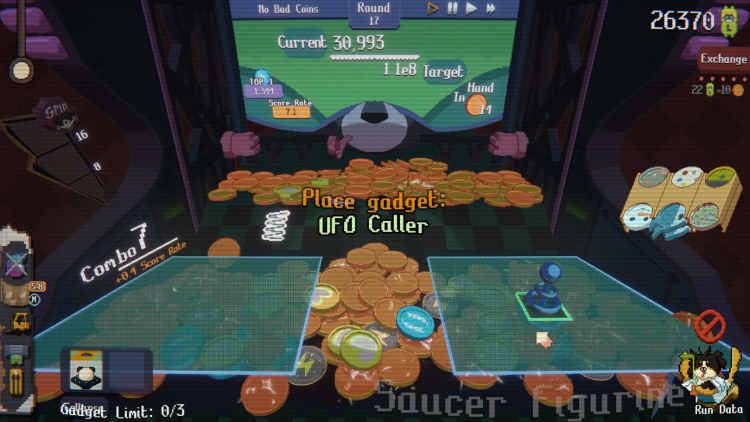
Meta-progression occurs through the collection of experience points and the unlocking of new items for the general pool. As players complete runs, they find new coin types and Chips that will appear in future games. The keychain system serves as the most significant permanent upgrade path. Keychains provide substantial buffs that the player can equip before starting a new run. These can range from increasing the initial coin count to granting a specific special coin at the start of every game.
Some of these permanent upgrades feel significantly more powerful than others. A keychain that grants an extra upgrade slot provides a massive advantage over one that offers a small percentage chance for a random effect. This disparity in value can make the meta-progression feel uneven at times. However, the constant stream of new unlocks provides a consistent sense of progress even after a failed run. The game rewards persistence and experimentation by slowly expanding the tactical options available to the player.
Visual Fidelity and Technical Performance
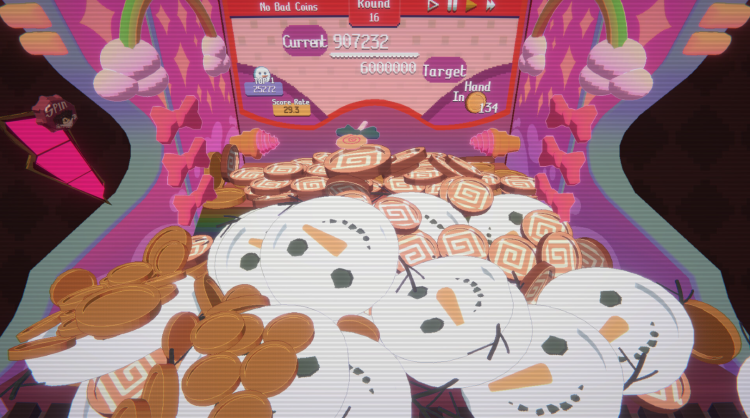
The art direction by Ming Tang utilizes a blend of 2D and 3D assets to create a tactile environment. Every coin has a distinct visual identity, allowing the player to recognize special modifiers at a glance even in a crowded field. The coins have a metallic sheen and react realistically to the lighting in the virtual cabinet. Sound design supports this physicality with weighty clinks and metallic thuds as coins impact the tray and each other. These sensory details are essential for maintaining the illusion of a physical machine.
Technical performance remains mostly stable, though the physics calculations can tax the system during peak chaos. When multiple explosions, vortexes, and towers occur simultaneously, the frame rate may drop significantly. The developer has described this as a slideshow effect in extreme cases. Despite the visual lag, the game continues to track every interaction and score change accurately. This issue is most prevalent on lower-end hardware or when players intentionally stack as many visual effects as possible to see the limits of the engine.
The game is currently optimized for PC and performs well on handheld devices like the Steam Deck. The tactile nature of the coin-pusher mechanic is well-suited for portable play. There is a clear community desire for mobile and console ports, though none have been formally released at this time. The simple input requirements make the title a prime candidate for touch controls in the future. As it stands, the PC version provides a polished and responsive interface for navigating the complex physics of the coin tray.
Verdict
The title successfully adapts a physical arcade mechanic into a complex digital strategy game. Repetitive early rounds and inconsistent upgrade values represent the only significant mechanical flaws.
RACCOIN: Coin Pusher Roguelike is an 8/10 game. The deep synergy between special coins creates massive replay value.
Pros
- Physics interactions create emergent gameplay moments.
- Over 150 special coins support diverse build strategies.
- Sound design and visual feedback enhance the physical weight.
Cons
- Early game rounds feel slow during repeated runs.
- Keychain upgrades provide inconsistent power benefits.
The development team at Doraccoon has built a functional roguelike around a simple physics premise. The volume of special coins ensures that different strategies remain viable across multiple runs. Players looking for a deep strategy game based on physics and probability will find a polished experience here.
Exploring the Best Singleplayer Games 2026 is a reminder that solo gaming still offers some of the most immersive stories, memorable characters, and emotionally rich experiences you can enjoy at your own pace.


 Det har lyckligt kopierats... Tack för att du delar vårt innehåll!:


5% insättningsbonus upp till 100 ädelstenar

0% avgifter på insättningar och uttag.





11% insättningsbonus + FreeSpin


EXTRA 10% INSÄTTNINGSBONUS + GRATIS 2 HJULSPINN

Gratis case och 100% välkomstbonus


5 gratisfodral, daglig gratis & bonus

3 gratis casinos och en bonus på 5% på alla kontantinsättningar.

+5% till insättning




Kommentarer